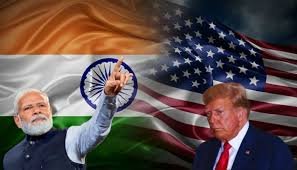
Damage caused to Indo-US strategic relations by Donald Trump’s ego-driven and increasingly autocratic style of governance in his recent year of disruptive foreign policy has been real, but it is neither irreversible nor terminal. Indo-US ties were not built on a single leader, a single party, or even a single decade. They were constructed slowly over more than twenty-five years through converging strategic interests, institutional linkages, military interoperability, economic integration, and a shared anxiety about the rise of an assertive China. While Trump’s abrasive diplomacy, transactional worldview, and contempt for alliances strained trust, the foundations of the partnership remain far deeper than the turbulence of one presidency.
India and the United States began their strategic convergence in the late 1990s and early 2000s when both realized that a stable Asian balance of power required cooperation between the world’s largest democracy and the world’s oldest. Since then, defense agreements, intelligence-sharing frameworks, joint military exercises, technology transfers, and diplomatic coordination have steadily expanded. None of these mechanisms vanished under Trump. What did erode was the sense of predictability and mutual respect. Trump treated foreign policy as a personal negotiation, where pressure, public humiliation, and threats were tools to extract concessions. This style might have worked with weaker states, but with India it produced resentment and suspicion, particularly when he lectured New Delhi on trade deficits, immigration, and defense purchases as if the relationship were merely a commercial transaction.
Yet it is precisely because the Indo-US partnership is rooted in structural realities that recovery is not only possible but likely. China’s expanding military presence in the Indian Ocean, its border pressure on India, and its technological and economic coercion have not diminished. In fact, they have intensified. For Washington, India remains the only Asian power with the size, geography, and political will to balance China on land and sea. For New Delhi, the United States remains the only country capable of providing advanced technology, intelligence, and diplomatic backing against Beijing’s growing assertiveness. These realities did not change because Trump offended allies or indulged in personal bravado.
What must change, however, is the tone and credibility of American diplomacy. Trust in international relations is not sentimental; it is strategic. Trump’s habit of praising authoritarian leaders, undermining democratic partners, and treating alliances as burdens rather than assets made Indian policymakers question whether the United States would stand firm in a crisis. India does not want to replace dependence on one great power with dependence on another that behaves unpredictably. For recovery to occur, Washington must demonstrate through consistent actions that it values India as a strategic partner rather than a customer or subordinate. That means restoring respect for diplomacy, honoring commitments, and avoiding public pressure campaigns that humiliate rather than persuade.
One of the most important tools for repairing the damage is institutional continuity. The Indo-US relationship today is not just between presidents and prime ministers; it is between militaries, bureaucracies, scientists, and businesses. The Quad framework, intelligence cooperation, and defense interoperability programs operate through hundreds of officials who have built habits of coordination over years. These networks did not disappear under Trump, even when the political atmosphere became toxic. A future US administration that empowers these institutions and allows them to function without political interference can rapidly stabilize the relationship. In diplomacy, professional continuity is often more important than charismatic leadership.
Economic engagement also offers a pathway to recovery. Trump’s trade wars and tariff threats alienated India by framing the relationship in zero-sum terms. A more balanced approach that recognizes India’s development needs while encouraging market reforms could rebuild goodwill. The two economies are complementary in many areas, from technology and pharmaceuticals to energy and defense manufacturing. If Washington supports India’s integration into global supply chains as an alternative to China, it can transform economic cooperation into a strategic asset. India, in turn, benefits from American investment, technology, and market access, which strengthens its long-term strategic autonomy.
Another critical element is technology and security cooperation. The future of power lies not just in armies and navies but in artificial intelligence, cyber capabilities, space, and semiconductors. Trump’s inward-looking and chaotic governance made the US appear unreliable as a technology partner. A stable and forward-looking US strategy that treats India as a co-developer rather than merely a buyer can restore confidence. When India sees the United States sharing sensitive technology and investing in joint innovation, it signals that Washington views New Delhi as a long-term strategic equal, not a disposable ally.
Diplomatic symbolism also matters more than it may appear. Trump’s tendency to personalize relationships meant that disagreements became public spectacles. Repairing trust requires a return to quiet diplomacy, where differences are managed privately and common interests emphasized publicly. India values dignity and strategic autonomy; it does not respond well to pressure politics. A US administration that respects this will find India far more willing to cooperate, even on difficult issues like trade, human rights, or regional diplomacy.
It is also important to recognize that India itself has become more confident and less dependent over the past two decades. New Delhi today has multiple partners, from Russia and Europe to Japan and the Gulf states. This gives it leverage but also responsibility. India does not need to forgive Trump personally to move forward with the United States institutionally. It can separate one leader’s behavior from the long-term national interests of the two countries. That is how mature states conduct foreign policy.
In a broader sense, the question is not whether the United States can erase the memory of Trump’s ego and autocracy, but whether it can demonstrate that those traits do not define America. Democracies are messy, but their strength lies in correction. If the US political system shows that it can reject unpredictability, recommit to alliances, and act with strategic discipline, India will respond. The partnership was built to withstand shocks, and Trump, for all his noise and disruption, did not alter the fundamental alignment of interests that brought the two countries together.
Ultimately, Indo-US relations are driven less by personal chemistry and more by geopolitical gravity. Two large democracies facing a shifting global order, an assertive China, and unstable regions around them have powerful reasons to work together. Trump’s behavior damaged trust and created unnecessary friction, but it did not change geography, economics, or strategic logic. With consistent diplomacy, institutional cooperation, and a renewed respect for partners, the United States can recover much of what was lost. The road back will require patience and humility, but it is open, because the foundation of the relationship was never built on ego in the first place.


Leave a Reply