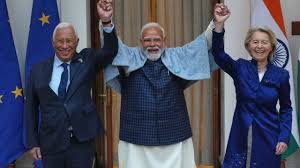
The idea of a “mother of all deals” and Trade Autonomy between the European Union and India would carry meaning far beyond tariffs, quotas, or market access; it would be a political and strategic signal to the world at a time when trade wars, protectionism, and economic nationalism are reshaping global behavior. In an era where major powers increasingly weaponize trade through sanctions, export controls, and supply-chain restrictions, a deep and ambitious EU–India agreement would suggest that large, diverse democracies still believe in negotiated interdependence rather than economic confrontation. That alone would make it a powerful counter-narrative to the prevailing mood of fragmentation.
Such a deal would show that trade is not dead as a tool of cooperation, but evolving. The global trading system is under stress: the U.S.–China rivalry has hardened into technological and industrial decoupling, regional blocs are forming, and “friend-shoring” is replacing the older language of pure globalization. If Brussels and New Delhi conclude a comprehensive arrangement covering goods, services, digital trade, green technologies, and resilient supply chains, it would demonstrate that the answer to trade wars is not isolation, but selective, value-based integration. It would tell the world that countries can reduce dependence on any single power without closing themselves off from global commerce.
For the EU, the message would be about strategic autonomy without protectionist retreat. Europe has learned hard lessons from energy dependence and supply disruptions. Partnering deeply with India—a large market, a major manufacturing base, and a key Indo-Pacific actor—would show that diversification can be achieved through partnerships, not walls. It would also underline Europe’s intent to act as a geopolitical player, not merely a regulatory power. A serious trade pact with India would link Europe more firmly to the Indo-Pacific, the region where the future balance of economic and strategic power is being shaped.
For India, such a deal would signal its arrival as a central pillar of the non-Western but non-authoritarian economic order. India has long balanced protection of domestic interests with gradual integration into global markets. A far-reaching agreement with the EU would show that New Delhi is confident enough in its economic trajectory to bind itself to high standards on issues like intellectual property, sustainability, and digital governance. In the context of trade wars, this would present India as a bridge: a country that engages the West, maintains ties with the Global South, and still preserves strategic autonomy. That balancing role is increasingly valuable in a polarized world.
To the broader international community, the symbolism would be equally important. Smaller and middle powers are watching great-power rivalry with concern, wary of being forced to choose sides. An EU–India “mega deal” would illustrate that alternative coalitions are possible—coalitions not built around military alliances alone, but around trade, technology, climate cooperation, and standards. It would suggest that the future global order may be more networked than bloc-based, with overlapping partnerships rather than rigid camps. That would be a reassuring message for countries seeking room to maneuver.
There is also a normative dimension. Trade wars often erode trust and weaken institutions like the WTO. A high-quality EU–India agreement, aligned with multilateral principles, could act as a building block rather than a wrecking ball. If it emphasizes transparency, dispute settlement, and sustainable development, it could set benchmarks for 21st-century trade rules. In that sense, it would not only be about commerce, but about defending a rules-based approach at a time when rules are frequently ignored.
Of course, such a deal would not end trade conflicts or erase strategic rivalries. But it would show that even in an age of economic coercion and geopolitical tension, major actors can still choose cooperation over confrontation. The deeper message to the world would be simple but significant: globalization is not ending; it is being restructured, and partnerships between large, pluralistic societies like the EU and India can shape that restructuring in a more stable and inclusive direction.

Leave a Reply