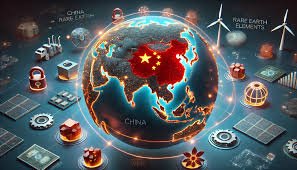
The Power and economy of nations in the next decade ,are likely to be deeply influenced — and in some cases determined — by who controls rare earth minerals and other critical metals, and this influence is already becoming visible in rising prices, strategic state actions, and intensifying global competition. Rare earth elements — a set of 17 metallic elements like neodymium, dysprosium, and terbium — play a central role in modern technologies from electric vehicles and wind turbines to advanced semiconductors and military systems. These minerals are indispensable because they are key inputs for high-performance magnets, batteries, optics, and the electronics that underpin both consumer industries and national defense capabilities. As global demand for electrification, renewable energy infrastructure, and high tech continues to surge, rare earths have moved from niche commodities to strategic assets, making their control a cornerstone of economic and geopolitical strength.
China’s dominant position in the rare earth supply chain has already reshaped the global landscape. Beijing controls a large share of global rare earth mining and an even larger share of the critical refining and separation capacity that turns raw ore into usable materials. Because processing requires sophisticated technology, environmental management, and industrial infrastructure, few countries can compete at scale, and China’s early investment created a near-monopoly. This enables Beijing not only to influence global pricing but also to wield rare earth policies as tools of geopolitical leverage. For instance, periodic export restrictions and licensing requirements tied to national security considerations have caused price volatility and exposed vulnerabilities in Western industries that rely on stable supply for manufacturing.
These dynamics have had real impacts on prices and supply chains. In some cases, individual rare earth components have seen dramatic cost increases due to trade tensions and export controls, which in turn put pressure on industries like semiconductor manufacturing where those materials are critical. Such sharp price movements ripple through global markets because supply is tightly constrained and demand is rapidly rising. This volatility is precisely the sort of environment where nations without secure access to resources find themselves at an economic disadvantage, forced to pay premiums or suffer industrial bottlenecks.
Major powers are responding to these pressures with intensive strategic competition. The United States, for example, has increased government investment in domestic rare earth mining and processing capacity and has taken equity stakes in key companies as part of efforts to reduce dependence on external suppliers. Likewise, alliances such as those between the U.S. and Australia involve significant investments to develop alternative sources of critical minerals and create more resilient supply chains. These moves are not just economic decisions; they are national security strategies designed to secure technological leadership and industrial autonomy in the face of a rival that controls much of the existing global supply infrastructure.
At the same time, resource-rich but weaker nations find themselves in complex and often unequal negotiations with powerful buyers and strategic investors. Countries in Africa, Southeast Asia, Latin America, and even the Arctic region are being courted for their untapped deposits of rare earths and other critical minerals. While harnessing these resources offers opportunities for development and revenue, it also exposes these nations to influence from larger powers seeking favorable terms, long-term access, or strategic footholds. In some cases, the drive for foreign investment and capacity building can lead to compromises on environmental protection, labor rights, or economic sovereignty, raising concerns about the “resource curse” where dependency on a single export commodity undermines broader national development.
The competition over rare earths is part of a broader shift in how economic power is defined in the 21st century. In previous eras, access to oil and coal was a defining factor in industrial and military power; today, access to the materials that drive digitalization, clean energy, and advanced defense systems may be the key differentiator between economic leaders and laggards. Governments recognize that controlling critical mineral supply chains — from mining to refining to manufacturing finished products — enhances their technological edge and reduces vulnerabilities in times of geopolitical tension. This recognition has led to policies that emphasize strategic reserves, domestic production incentives, and international partnerships aimed at stabilizing supplies and insulating national industries from external disruptions.
The world isn’t headed toward a simple duplication of supply chains; rather, we are witnessing a complex realignment of global power structures where technology leadership, economic resilience, and geopolitical influence are interwoven with access to rare earths. Dominant producers with robust processing and manufacturing ecosystems will likely shape global standards, pricing mechanisms, and trade norms, while nations that cannot establish secure access risk becoming dependent on external powers for key inputs into their economic and defense sectors. This could translate into economic disadvantage, strategic vulnerability, and reduced bargaining power in international diplomacy.
In the coming decade, therefore, rare earth minerals and other critical metals will not just be commodities traded in bulk markets; they will be central to national strategies for economic growth and geopolitical influence. As countries invest in diversifying supplies, expanding processing capacity, and negotiating complex international agreements, the control of these resources will increasingly determine who leads in technology, who secures economic stability, and who holds leverage in global affairs — making rare earths a defining factor in the power and prosperity of nations.



Leave a Reply