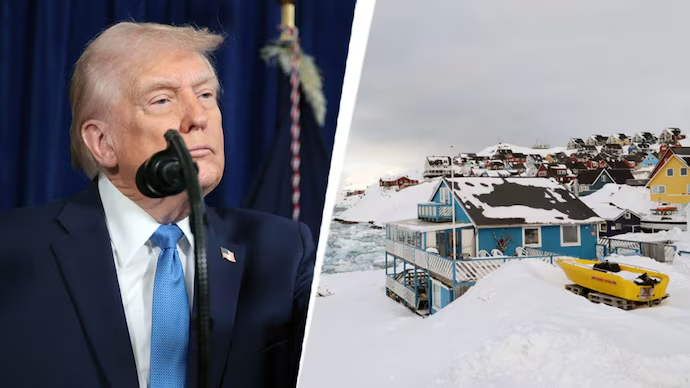
Donald Trump’s repeated expressions of interest in acquiring Greenland, framed bluntly as a real estate–style purchase, may have seemed theatrical, but they exposed a deeper vulnerability in US diplomacy: the erosion of credibility among allies. In international politics, power rests not only on military and economic strength but also on trust, predictability, and respect for sovereignty. When a U.S. president openly treats the territory of a close NATO ally, Denmark, as a negotiable commodity, it sends a signal that even the closest partnerships are conditional and transactional. This has consequences that reach far beyond the Arctic.
Greenland occupies a crucial strategic position between North America and Europe, hosting key U.S. military installations and sitting astride emerging Arctic sea lanes. Yet the manner in which Trump pursued the idea mattered more than the idea itself. Rather than quietly negotiating enhanced basing rights or deeper cooperation, he publicly floated buying the island and canceled a state visit when Denmark refused. To many allies, this suggested a disregard for diplomatic norms and an assumption that U.S. power entitles it to demand whatever it wants. In an era when smaller states already feel squeezed by great-power competition, such behavior reinforces the fear that Washington may treat allies as assets rather than partners.
This credibility gap feeds into a wider anxiety about the reliability of U.S. commitments. NATO, the backbone of the transatlantic order, depends on the belief that an attack on one will be met by all. When the U.S. president repeatedly questions the value of alliances, demands “payment” for protection, or hints at territorial ambitions involving allies, it weakens that belief. European governments begin to hedge, investing more in their own defense and exploring alternative diplomatic arrangements, not because they want to abandon the United States but because they cannot be sure it will always be there in the same way.
The Greenland episode also intersects with a broader global shift. As China expands its economic and diplomatic reach and Russia asserts itself militarily, many U.S. allies are already navigating a more complex landscape. They seek to balance relations with multiple powers to avoid overdependence on any one. When Washington appears erratic or self-interested, it accelerates this trend. Countries may not become outright foes, but they become more independent, less willing to align reflexively with U.S. positions on issues ranging from trade to sanctions to technology.
In Europe, this could mean a stronger push for strategic autonomy. France and Germany have long argued that Europe should be able to defend itself and shape its own foreign policy without always deferring to Washington. Episodes like the Greenland proposal, combined with trade disputes and unilateral U.S. decisions on Iran and climate agreements, strengthen their case. Over time, this could lead to a looser, more conditional transatlantic partnership, where cooperation is selective rather than automatic.
Beyond Europe, the message resonates in Asia and the Middle East as well. Allies such as South Korea, Japan, and Saudi Arabia watch how Washington treats Denmark and Greenland and draw conclusions about how they themselves might be treated in a crisis. If U.S. policy seems driven by short-term advantage or personal impulses rather than shared values and long-term strategy, they too will look for ways to diversify their security and economic ties. This creates space for China and Russia to offer themselves as alternative partners, even if they cannot fully replace the United States.
None of this means the United States is doomed to lose its alliances. America still offers unmatched military power, deep financial markets, technological leadership, and a network of relationships built over decades. But credibility, once damaged, takes time to restore. Future U.S. leaders will have to work harder to reassure partners that Washington respects their sovereignty and sees alliances as mutual commitments rather than business deals. They will need to demonstrate consistency across administrations, so that allies do not feel whiplashed every four years.
The Greenland affair, then, was less about a frozen island than about the norms that underpin global order. By treating territory as something to be bought and sold between unequals, Trump highlighted a worldview that many allies find unsettling. If that mindset were to become a permanent feature of U.S. policy, it would indeed risk turning friends into wary, semi-detached partners, and in some cases into rivals. The future of U.S. alignments will depend on whether America can reaffirm that leadership is built on trust and cooperation, not just on leverage.



Leave a Reply