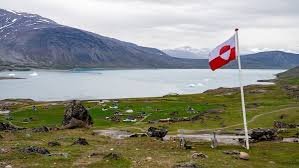
How much the “fire” over Greenland may escalate must be understood by tripolar interest involving the US, Russia, and Europe’s search for strategic autonomy. The question of how much the “fire” over Greenland may escalate must be understood less as an imminent military flashpoint and more as a slow-burning geopolitical contest shaped by climate change, great-power rivalry, and Europe’s search for strategic autonomy. Greenland, long perceived as a remote Arctic territory, has moved to the center of tripolar interest involving the United States, Russia, and Europe. This interest is driven by melting ice, emerging sea lanes, untapped resources, and the island’s unmatched strategic location between North America and Eurasia. The escalation, therefore, is likely to be gradual, multidimensional, and persistent rather than explosive, yet its implications could reshape Arctic stability for decades.
For the United States, Greenland is fundamentally a strategic asset rather than a prize for territorial expansion. Washington’s interest is rooted in defense, early-warning systems, and maintaining control over the North Atlantic–Arctic corridor. The Thule Air Base, now part of broader missile defense and space surveillance architecture, makes Greenland indispensable to U.S. security planning. As Russia expands its Arctic military infrastructure and China signals long-term economic ambitions in the polar region, the United States sees any dilution of its influence over Greenland as a direct risk. This explains the assertive American posture, which at times has appeared clumsy or provocative, but is ultimately driven by fear of strategic encirclement rather than imperial nostalgia.
Russia’s interest in Greenland is indirect but significant. Moscow does not need territorial access to Greenland to influence Arctic dynamics; it already controls vast Arctic coastlines and is rapidly militarizing them. However, Russia views Greenland as part of the wider Arctic balance of power. A stronger U.S. footprint in Greenland strengthens NATO’s northern flank, potentially limiting Russia’s freedom of maneuver in the Arctic Ocean and North Atlantic. Consequently, Russia’s response is unlikely to involve Greenland directly but will manifest through military exercises, submarine patrols, and diplomatic signaling designed to contest U.S. dominance in the region. The escalation here is strategic and psychological, reinforcing a security dilemma where each side’s defensive measures are perceived as offensive by the other.
Europe’s role adds complexity rather than raw power to the equation. Greenland is politically linked to Denmark and economically tied to the European Union, even though it left the EU decades ago. Europe’s interest is primarily normative and economic, centered on sustainable development, environmental protection, and preventing the Arctic from becoming another arena of militarized great-power rivalry. However, Europe’s capacity to enforce these preferences is limited. Denmark, despite its sovereignty claims, lacks the military power to independently shape outcomes, while the EU remains divided between Atlanticist instincts aligned with the United States and a desire for greater strategic autonomy. This internal ambivalence weakens Europe’s ability to act as a stabilizing pole.
The most likely form of escalation will occur through economic competition and political influence within Greenland itself. As ice melts, access to rare earth minerals, hydrocarbons, and fisheries becomes more viable. Greenland’s small population and aspiration for greater autonomy make it vulnerable to external courtship. Investment offers, infrastructure projects, and development assistance can quickly become instruments of geopolitical leverage. The United States will seek to block any external actor, especially those aligned against Western interests, from gaining economic footholds that could translate into strategic influence. Europe will emphasize rules, transparency, and sustainability, while Russia will quietly exploit any opportunity to weaken Western unity rather than dominate Greenland directly.
Climate change acts as a silent accelerator of this fire. As Arctic routes such as the Northern Sea Route gain importance, Greenland’s geographic position becomes more valuable as a logistical and monitoring hub. This raises the stakes for surveillance, satellite coverage, and naval presence, increasing the risk of miscalculation. While no actor desires open conflict in the Arctic, the density of military assets and competing interests increases the probability of incidents, especially during periods of global tension elsewhere. Escalation, therefore, is more likely to be linked to crises outside Greenland that spill into the Arctic theater.
Ultimately, the “fire” of Greenland will escalate in intensity but remain controlled, constrained by mutual deterrence and the high costs of open confrontation. The real danger lies not in invasion or annexation, but in the erosion of cooperative Arctic governance. If trust collapses and institutions fail, Greenland could shift from being a zone of managed competition to one of hardened rivalry. In that sense, Greenland is less a spark than a mirror, reflecting the broader trajectory of U.S.–Russia relations and Europe’s struggle to define its role in a tripolar world.



Leave a Reply